Showing posts with label Jean Xin. Show all posts

Wednesday, March 31, 2010

ZOMG…College!


By Yijing Xin

I'm writing on the eve of April 1, the nerve-wracking date on which Ivy League decisions are released, and it finally hit me that the end of the long, winding, and drama-filled road of high school is almost here. While high school is a worthy experience in and of itself, for much of The Hawkeye's readership, it also represents a stepping stone to college, the mythical place where your parents can't tell you what to do. However, once a student becomes a senior, the pie-in-the-sky dream of college becomes a very stressful reality. Suddenly, you start reading college confidential forums and hyperventilate because a bunch of insecure, but overachieving Ivy-hopefuls are jumping up and down typing, "Chance me! Chance me!" A mountain of application paperwork piles up, you develop a permanent headache due to your inability to come up with a good college essay, and adults won't stop asking you about college. It's stressful, it's difficult, but it can also be very rewarding (warning: when you start to think it is fun, you need to go outside and get some sunlight). Nothing I can write here will make the stress disappear, but from the class of 2010, here are some helpful college application tips. Feel free to leave questions in the comments as well.

  • It's not the end of the world. Whether you get in or you don't, the college you go to is important, but it doesn't determine your identity.
  • Don't be afraid to apply to your reach schools; in the words of Nikhil Sethi, "Never underestimate yourself." Even if you don't think you're qualified, there's always a chance!
  • When it comes to average GPA's and median test scores, remember that 50% of the class is above it and 50% is below it. It's okay if you don't have a 4.0.
  • Write your college essays early. I had 5 good essays rejected by the powers that be (i.e. Mr. Powell and Mrs. McDonough). You do not want to be facing an impending deadline of doom if that happens to you.


  • Do extracurricular activities that you enjoy.
    There are so many opportunities at Prairie for you to get involved with the school community, but it's especially important to find extracurricular activites to which you are really willing to dedicate your time and effort. A box on a resume means little compared to a great short answer detailing one of your experiences.
    • For those interested in the top schools, I would also suggest trying to find leadership positions and considering independent research.
  • Challenge yourself during high school, not even a stellar essay and a 2400 SAT can save a transcript that so clearly lacks rigor.
  • Prioritize and organize. Abby Gaertig suggests, "Figure out all of the due dates and fill out the apps in order of when they're due, or the most important ones first."
  • Keep track of standardized tests that you need to do and testing dates. You don't want to be taking an SAT, ACT, and three SAT II's within a few weeks of each other.
  • Don't procrastinate. Dan Beggs advises, "Get things out quickly so you can catch priority deadlines."
  • "Stop putting 'f***' in your statuses by junior year."-Ben Greene
  • Ben also suggests, "If a college, like St. Olaf, asks for an optional photograph to accompany your common app- never include one displaying you, your friends, and several red cups."
  • Realize you won't get in everywhere. 93 out of 100 students are rejected from Harvard. It happens.
  • Apply to the schools that are right for you, not the ones that Newsweek tells you that you should attend.
  • Remember, there's no prize for getting into the most schools, just the one you really want to go to.
  • Usually, TPTB (The Powers that Be) are right when they tell you something about your college app, but sometimes you must trust your own instincts. If you really like a certain essay (and have a legitimate reason for loving it, not just because you don't want to write another), use it.
  • Don't spend hours lamenting all the things you didn't do during high school, by senior year, it's too late for you to regret not taking 10 AP classes or not doing independent research. Move on, get your laptops powered up, and start typing.
Hopefully, this motley collection of tips will provide some help when you reach your senior year. Good luck!

Wednesday, December 2, 2009

Kennedy Space Center: No Boundaries to Possibility


By Jean Xin


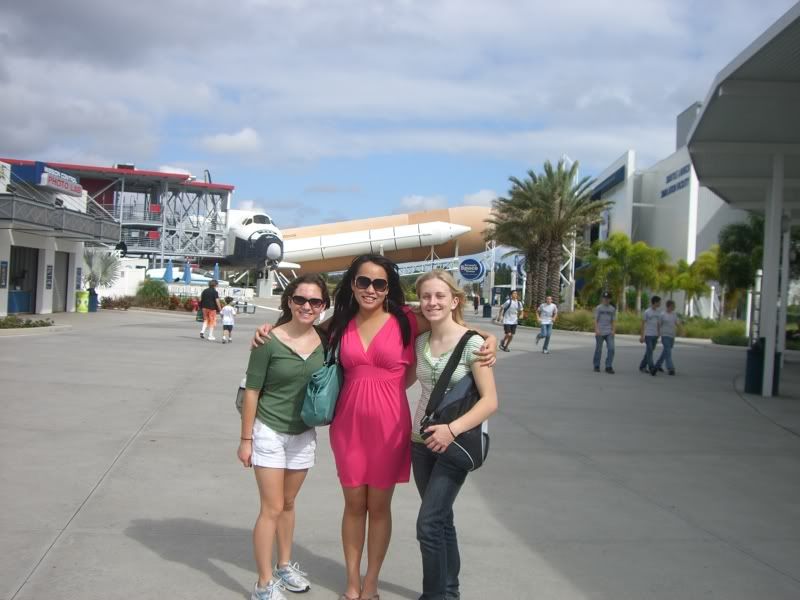
The warm, humid Florida air hit me the second I stepped off the plane. Huge smiles spread across our faces as we realized that we were actually here. While I know that nobody likes looking through other people's vacation photo albums and getting to hear all about someone else's fun trip at length while they are stuck in Wisconsin, I ask you to bear with me, especially if you're interested in science. Aside from basking in the Florida sun (well, for two of three days, it was actually warmer in Wisconsin on one of them), we also met so many passionate people dedicated to absolutely fascinating research.


Dr. Weaver, Mr. Dan Barry, Tatiana Barry, Julie Iuliano, and I were fortunate enough to stay in Florida from Nov 11 to Nov 13, and it was am extraordinary experience. During late April/early May of 2009 (conveniently right in the middle of AP Exam induced panic, but that's another story altogether), we entered the No Boundaries contest after Mr. Vanden Heuvel brought it to our attention. It started as a good alternative to making a circuit (which reminds me a bit too much of daycamp craft projects and was rather conducive to third degree burns) or a photography contest for which I had no inspiration. However, as the idea evolved, it quickly became a lot of fun, despite the weekend during which I worked on it for about 6 hours straight on Saturday and then another 5 hours on Sunday. My eyes swam with HTML tags. We created a website and promotional video marketing a STEM career of our choice, astrobiology, to youth. According to the NASA educators we spoke to, the USA is suffering a severe shortage of people going into Science, Technology, Engineering, or Math fields. This is creating great concern for the future workforce of the large engineering firms, and especially for NASA, as they can only hire American citizens. While the making of our project was a story in and of itself, let's fast forward a few months to the actual trip.

Unfortunately, Kaitlyn could not make it, but the rest of us arrived at the Orlando airport the evening of November 10, and after a desperate scramble to find late night food, turned in quickly. The next day, we were welcomed to the Kennedy Space Center by a NASA educator. We had expected to spend only a few hours there, but we managed to stay the whole day. Kennedy Space Center is a great educational experience combined with a lot of fun touristy things. Some highlights include the Rocket Garden, Robot Scouts: Trailblazers for Human Exploration! (This would become a motto for the remainder of the trip), seeing two phenomenal IMAX films narrated by Tom Hanks and Tom Cruise, and The Shuttle Launch Experience, a relatively unexciting ride whose buildup was fantastic (complete with giant television screens, robotic arms, and way too many fog machines). Educationally, there were very accessible and well-designed signs everywhere, which gave a layman's explanation about the space program and application stemming from space research (e.g. the materials science research for the shuttles provide us with many of the heat resistant materials, and even metals, that we use today). If you're ever down by Orlando, it's definitely worth the stop.


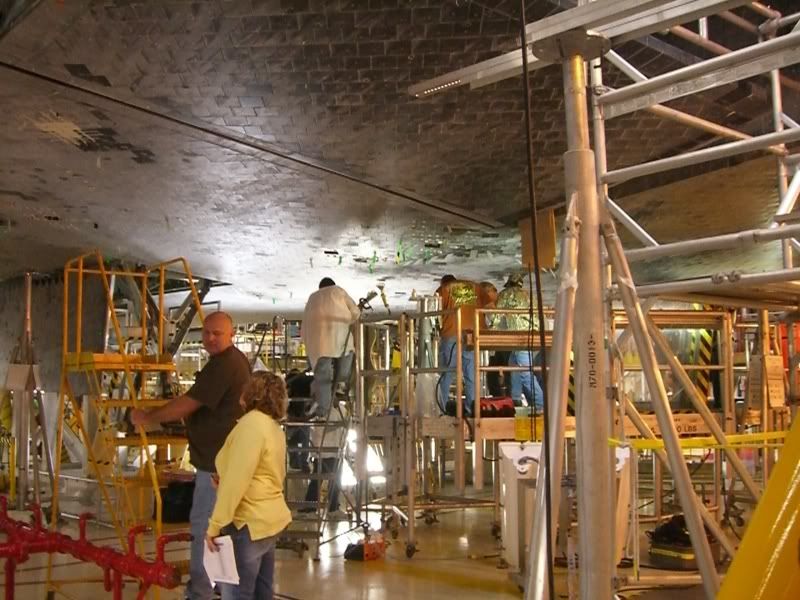
Due to our fantastic time management skills, we worked for about six hours straight on the presentation we were to give NASA, which induced significant coffee consumption the next morning. Nonetheless, the five of us squished into the car, and shipped off to NASA. After a bit of a run-in with security (not nearly as dramatic as it sounds), we met people from NASA education and boarded an official government minivan. Our first was the Orbiter Processing Facility, where we were catapulted into a world of a zillion safety hazards, scaffolding, and some really excited people. I looked up, and that's when I realized that I was standing directly under the space shuttle Discovery. Someone with a great vertical probably would have been able to touch it. We talked about the insane temperatures that these tiles could withstand, despite the fact that they felt like a piece of Styrofoam. Most of the tiles on Discovery have been there since 1984! Seeing the orbiter up close was phenomenal, especially as we learned random facts. (Did you know that the external fuel tank, the giant orange thing, is held on by one bolt?) What struck me most was the atmosphere in the building, though. Instead of the daily drudge of your average corporate office or high school, everyone there was having fun and doing what they loved. Here's my shameless plug for NASA, but the employees at the OPF are truly being paid to do what they love, and how many people can say that? It's certainly enough to make me push a STEM career up on my possibility list. After, we went to see the engines after being ushered into a pristine white room, with a billion posters that warned of F.O.D. I know next to nothing about engines, but these are engineering miracles. Their material is designed to withstand the temperature of liquid hydrogen (−423.17 °F) and the temperature encountered in reentry (upwards of a thousand degrees). In fact, the nozzles on a space shuttle are actually made of little tubes, where liquid hydrogen flows as both coolant and fuel. They are capable of producing thrust up to 1860 kN at sea level- translated, it's insane. Ahem, excuse the geek-out. If you thought that sounded cool, though, you really ought to consider a STEM career.

After seeing the orbiter facilities, we were interviewed and spent some time at the launch pad, though we couldn't go up, since it was so close to the departure of the shuttle Atlantis and there were too many safety concerns (which is saying something, considering how many tanks of liquid gases I walked past). We also saw a gator, as KSC is also a wildlife reserve (I still don't really get that logic, but let's roll with it.) After that, we headed over to the Space Station Processing facility, another pristinely white building complete with a sticky floormat to prevent you from tracking in debris. Though much of the ISS is already up in space, we saw modules which bring waste, new clothes, etc. to and from the ISS. The Italians named them Leonardo, Donatello, and Michelangelo. Yes, like the Teenage Mutant Ninja Turtles, although they were giving a nod to the great Renaissance talents. There's even a ninja turtle on their logo. The only (two, technically) word to describe the SSPF (NASA really likes acronyms and warning labels) is sci-fi.

Finally, we explored the Materials Science and Life Sciences labs. As far as materials science goes, *please prepare for geekiness overload,* I got to ogle electron microscopes and pretty much every spectrophotometer imaginable. They analyze unknown samples, since every minute detail must be checked and double checked. We took a quick break from touring here to give a presentation to the NASA education staff. Tip for all the Hawkeye 2.0 readers: if you don't want to pay for graduate school, go study a science. Honestly though, STEM careers have a lot of potential, not only for your career, but for the betterment of the world.

Afterwards, we went to the life sciences/astrobiology lab (appropriately, since we studied astrobiology) to see some really amazing experiments. First, we saw chambers that mimicked conditions for outer space living, and explored an experiment in which plants are grown in colored LED light (plant pigments only absorb a small range of wavelengths of light efficiently, but they also need other wave lengths for growth modulation). The second scientist we visited ran into a bit of a disaster that morning. After his microbial spore experiment spent about a month exposed the harshness of outerspace (makes you appreciate our ozone layer!), his experiment was shipped back to him that morning with a giant orange sticker that said, "X-rayed by the United Postal Service." While highly unlikely, these hardy microbial spores might have survived the radiation of space only to be killed by the USPS. Yikes. Finally, we talked to a scientist who has created the world's best "Mars Chamber," a pressure, temperature, radiation, and light controlled cylinder to mimic the conditions on Mars. In order to avoid "space pollution," we must be certain that we don't bring microbes to Mars that could mutate. He has been testing the hardiest bacteria on the planet, and none have survived the UVC exposure of Mars, so you can put that horror movie to rest for now.

Almost 1500 words later-- we basically had an absolutely amazing time. We go the movies to witness fantasy, but they say the truth is stranger than fiction. There is so much amazing research happening right now, and we're the generation that will push it forward. Don't miss that opportunity.

Saturday, September 19, 2009

Letter from the Editor: Welcome!


Dear Hawkeye readers,

Welcome to the completely revamped Hawkeye! In honor of the twenty-first century, the continuation of this Earth and the trees upon it, and the sanity of the editors who now hate Adobe InDesign with a fiery passion, we have decided to put The Hawkeye online! However, we aren’t giving you carpal tunnel for nothing—we have also redesigned the content of The Hawkeye 2.0 to reflect what you want to read about. Here, you’ll find everything from movie reviews to fresh music, and a few Hawkeye originals such as Jake Zimmerman’s Pet of the Week.


The most exciting thing about The Hawkeye 2.0, however, is its ability to change rapidly. When we first started imagining this project, we bounced ideas all over the place, and what we realized is that we have no set agenda we need to cover. We’ll make sure you can get all of your relevant school discussion (e.g. Letter from the President, debates on school policy, etc.) but we also realize that school is just a part of our lives. We have tapped some of the best writers, trendsetters, and some of the most entertaining people from the Prairie Upper School to contribute to The Hawkeye this year. But that doesn’t mean we’re done! We want to hear from you and hear about what you want to read or write about! So just hit that charming little “Comment” link underneath a post and tell us what’s up. We are always looking for fresh ideas.

So let’s say you’re into soccer, science, and songwriting. We’ve got your back. By using the tagging function, you can simply click a link which will take you to the category/sub-blog of your choice. Only read what you want to, and skip over the boring bits! Also, if you suddenly realize that your résumé is a bit lacking, check out our classified ads for various extracurricular activities and service opportunities around the school. Hopefully, we can be useful, or if nothing else, entertaining. Welcome, browse around, procrastinate that history paper, we’re excited to see you here!

Sincerely,

Yijing Xin

Editor-In-Chief

PS- Every few weeks, I’ll write a post recommending some of the highlights of The Hawkeye, so always check back if you’re bored!

Followers